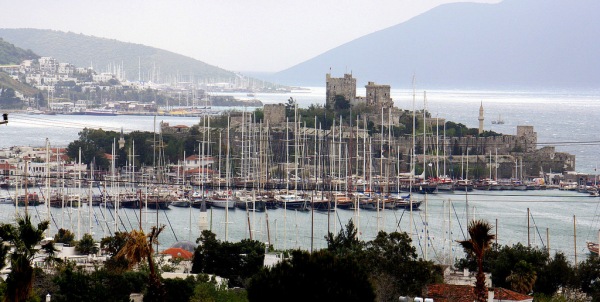
Nowadays better known to many as the gateway to Aegean Sea resorts, Bodrum (pop. 198,000) is also a fascinating ancient port city in southern Turkey, which we recently had the pleasure of touring. Its medieval castle and underwater museum are are just two of the many attractions we found to tell you about. But first, a captivating history.
Founded around 1,000 BCE as a Greek colony called Halicarnassus (and was the birthplace of among others the famous classical historian Herodotus), it came under Persian rule in 546 BCE, then was conquered by Alexander the Great two centuries later.
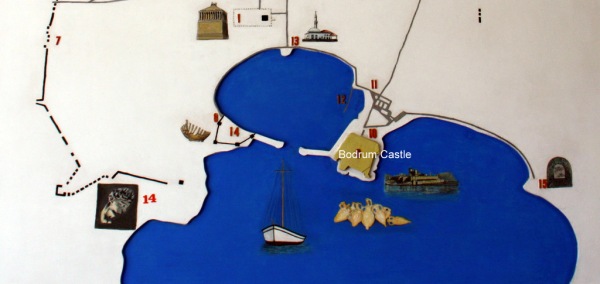
Building the Great Castle
Halicacarnassus eventually came under both Roman, Byzantine, and Ottoman rule, and in the early 15th century Ottoman sultan gave the Christian Knights of St. John (Knights Hospitaller), returning from one of the Crusades, order permission to build a castle on a rocky peninsula jutting out into the harbor to build a castle dedicated to St. Peter. Construction on the Castle of St. Peter started in 1404 and continued into the early 16th century.

The chapel was the first structure completed in 1406. It was followed by four towers, each named after the country of the Christian Crusader knights responsible for the construction, i.e., England, France, Germany and Italy.

Today the towers contain amazing sculptured carvings and relics from the sponsor countries.
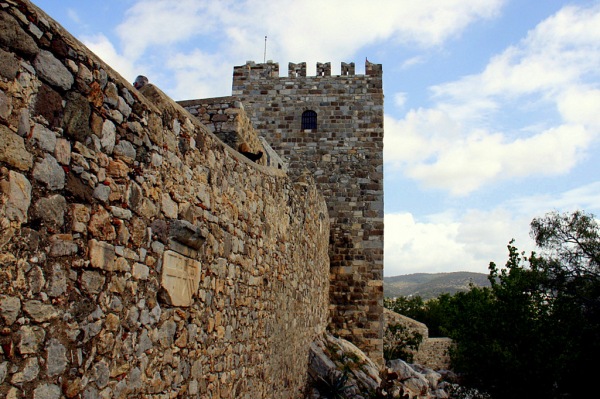
The walls and interior of this majestic castle and grounds are remarkably well preserved and maintained.

In the year 1523, and just as the knights were completing their fortification, the ruler of the Ottoman Empire, Suleiman the Magnificent conquered the entire area, including the castle. One of his first dictates was to convert the castle’s chapel into a mosque, which it remains today.

Since 1523, the castle has been a fortification, a prison, and a warehouse. In the early 1960s the Turkish Ministry of Culture turned the castle into an impressive history museum, and made it the home of the famous Bodrum Museum of Underwater Archaeology. The largest such exhibit of its kind in the world.

A Vision Begets a Museum
The oceans of the world are ancient beyond memory or record. Man has claimed dominion of the seas, yet the seas are endless and forever, and man is temporal. Throughout history, man has challenged the unrelenting seas in a contest that has extracted a toll of untold thousands of lives and ships — some laden with cargoes and immense riches — all resting on the sea floor and lost for millennia.
The museum planners realized that there were hundreds, if not thousands of ancient shipwrecks in the waters surrounding Bodrum. Many of these vessels were carrying fortunes, and a castle fortification would be the ideal place to display them. In 1964, the lower area of the Bodrum Castle was dedicated to the display of underwater artifacts excavated from shipwrecks found in the Aegean Sea. And by the way, no part of the museum is itself underwater, a frequent misconception because of the name.
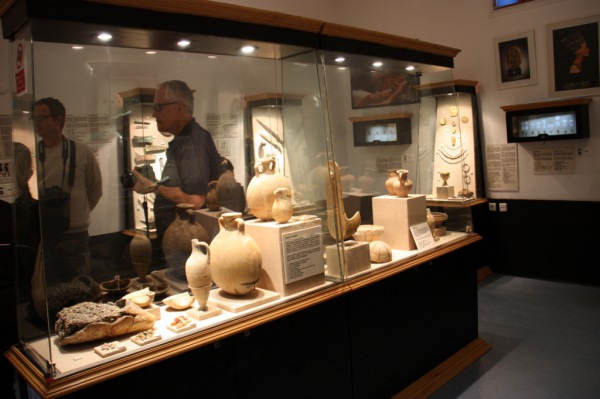
After laying submerged under dark waters for thousands of years, the mysteries so long hidden in the deep are brought to light by this fascinating museum.

It boasts 14 exhibit rooms of recovered relics of precious gems, jewelry, bronze, clay, iron and copper. One of the gold scarabs on display is inscribed with the name ‘Neferititi,’ the queen of Egypt; it's the only such artifact in existence.
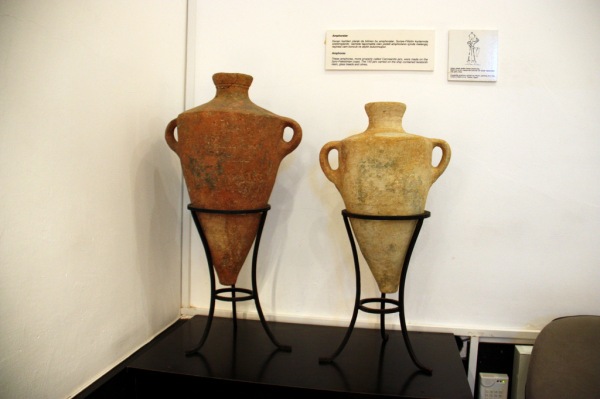
The museum also houses the world’s largest amphora collection, including 200 undamaged amphorae from the 5th century BC. An amphora is a container usually made of ceramic or clay and used to store wet or dry substances like grain or wine. Some date back to 10,000 years BC. Amphorae are particularly important to marine archaeologists because their unique designs help date the age of a shipwreck and the ship’s origin.

There are painstakingly reconstructed shipwrecks in the museum.
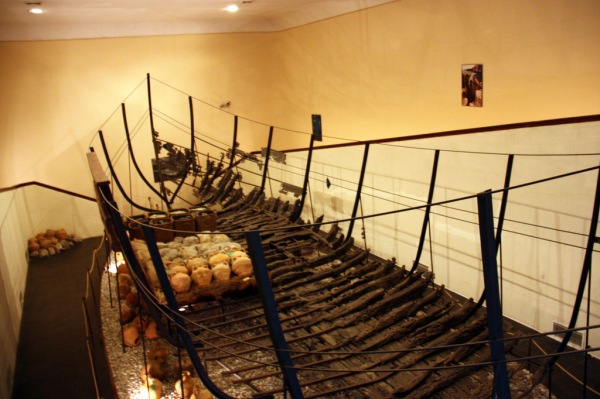
Thought to have originated in either what is today Cyprus or Syria/Palestine, the Uluburun dates back 3,500 years and is the world’s oldest surviving shipwreck.
Finding Undersea Treasures Today
Adventurers and treasure seekers, armed with ever-advancing technology continue to discover the secrets of the deep, but discoveries are gradual – the oceans still give up their own, reluctantly.
It is an interesting fact that most ancient wrecks occurred close to shore and in bad weather, and 95 percent of valuable relics have been discovered by sponge divers.
Before You Go

Before You Go
Check with your travel agent. Several of our tourist resources are now reporting unofficially that Bodrum Castle, and the Underwater Museum are closed to the public for an undetermined time and reason. Although Turkey was one of the sponsors of our trip, we have not been able to obtain an official statement. Whatever the situation, we hope it is temporary. The first class museums in Bodrum are not only interesting, but important to our understanding of the ancient world.
Happy travels!
The opinions expressed in our articles are the journalists’ alone, and have not been reviewed, endorsed or approved by any entity.
Copyright © 2018 Visit great vacation destinations with Wayne and Judy Bayliff.
Photos Copyright © 2018 Judy Bayliff.

Comments
I´ve been to Turkey several times but never to Bodrum. Now you´ve got me curious!